Showing posts with label artistic critique. Show all posts

Saturday, August 4, 2018

How do I draw from just my imagination?


Here are two approaches to drawing: Make something as much like an image from life as possible, and Make something that doesn’t exist outside of imagination.

Here is The Marc Kane, with an old sketch of us with our friend Jamison, the first day we ever hung out.
There were no pictures, but she had a strong picture in her mind. She uses realistic elements, but an imaginative style (1998), drawn from her vision.

Here's a still life nature drawing that uses mostly elements as they were layed out to my eye, and some arranged by my imagination.

Now, cartoonists often use an approach that works down the middle. They draw often simplified versions of real things, like cars, trees, animals, and might merge them with images that are not entirely realistic.

It’s a matter of style.
If you want a photo-realistic style, work from still life and photographs. Your question, however, suggests you’d like to try something without reference.

Sometimes, a masterful vision involves a perspective that is very difficult to attain or pose. The first one is Lewis Trondheim, illustrating Poppies of Iraq.
Jim Steranko, Steve Ditko, Paul Smith, Peter Max...I'm trying to remember who did the William Carlos Williams tribute...it's driving me nuts. I'll include Renoir, here, an Impressionist who used oil to make the color impression, used depth...but did not slavishly limit things in lines. Real people and flowers don't have thick lines around them at their limits, after all.

Depending on the story, or your tastes in portraits, you might like one of these over the other:


This last one, Rackham, drew things purely from imagination. INspired somewhat by nature, but super-normal, as Mattheson once put it.

You really have to ask yourself 'what's my purpose, this time out?' Sometimes, you are simply out to discover what's inside. In that case, decide how you feel about it later. What are you asking of your vision: what's your vision look like? Developing that sense of inner vision is the ultimate creative goal.

Do you want something never seen in real life? Mojo here, an Arthur Adams visual design, is an exaggeration of feelings we know all too well: what does his face tell you? What kind of world do you think he inhabits?

Yildiray Cinar, here, illustrates something unreal, but lights and crafts it in a way that lets it exist powerfully within its own reality.

Youka here, by me, was inspired by a real person. I wanted to express her warmth. I used a photograph- but she also represents a fictional character of mine.
Now this pencil drawing, including a mirror image, was inspired by real life model Max Wasa and her love of Dr. Who. But the vision came from my head, rather than copying a photo of anything.

Here, Emmryza DAwn, who you can find under the name, The Marc Kane, used a small book to sketch this image based on real life, but drawn from her vision- from purely her imagination. She is much stronger at this quality, in my opinion, than I. I can capture many loving details, but I never get to draw long enough to really develop an ability that comes naturally to her. It's a self-imposed, or predisposed, limitation.


HEre is a still life. I didn't use a medium I could erase, and my figure moved quite a bit. You can still get a sense of the real person.

This was made with no planning, really, to go in a Christmas card. NO photo reference, but, the style was done to evoke an effect (funny, I hope).


I will be honest with you: reference is great. IF you want to draw a real person or object, it’s best to start with basic layout, a stick-figure type underpinning, then add details. You might even make a cartoony style to represent these things, in which case you change details such as proportions. Mastery of realistic anatomy is a great start to drawing perspectives that seem to bend the rules.

When you say you ‘can’t draw without reference,’ what you literally mean is, you don’t like the results. They don’t satisfy your need to represent the subject in question.
So my advice is two-fold:
1. Learn to like what you make up from your head. Don’t expect it to be completely realistic. Let art take you on a journey: discover your imagination. Let your art represent things that have never been, in styles we don’t see in day-to-day life.
2. If you are still getting the basics down and want the option of being realistic, nothing replaces a good book like, Bridgeman’s anatomy guides, or a book by Burne Hogarth, or some other classicist. (Classicists are people who draw with realism in mind, primarily. Experientalists are on the opposite side of the wheel: they want to express states of mind and emotions, fantasies of form.) Practice drawing body parts with classic style; practice shading solid objects. There’s no replacement for practice, when it comes to producing these things from your mind. Conversely, there is no substitute for letting your mind flow- let go of the need to match a realistic standard and discover how to express yourself in your own style. I really recommend looking at ARt History and seeing the different approaches. You will see how artists uncovered secrets of perspective, especially in statuary, long ago- yet new movements arose that represented reality with different values than solid realism.

Be Chill, Cease ill

Monday, July 15, 2013

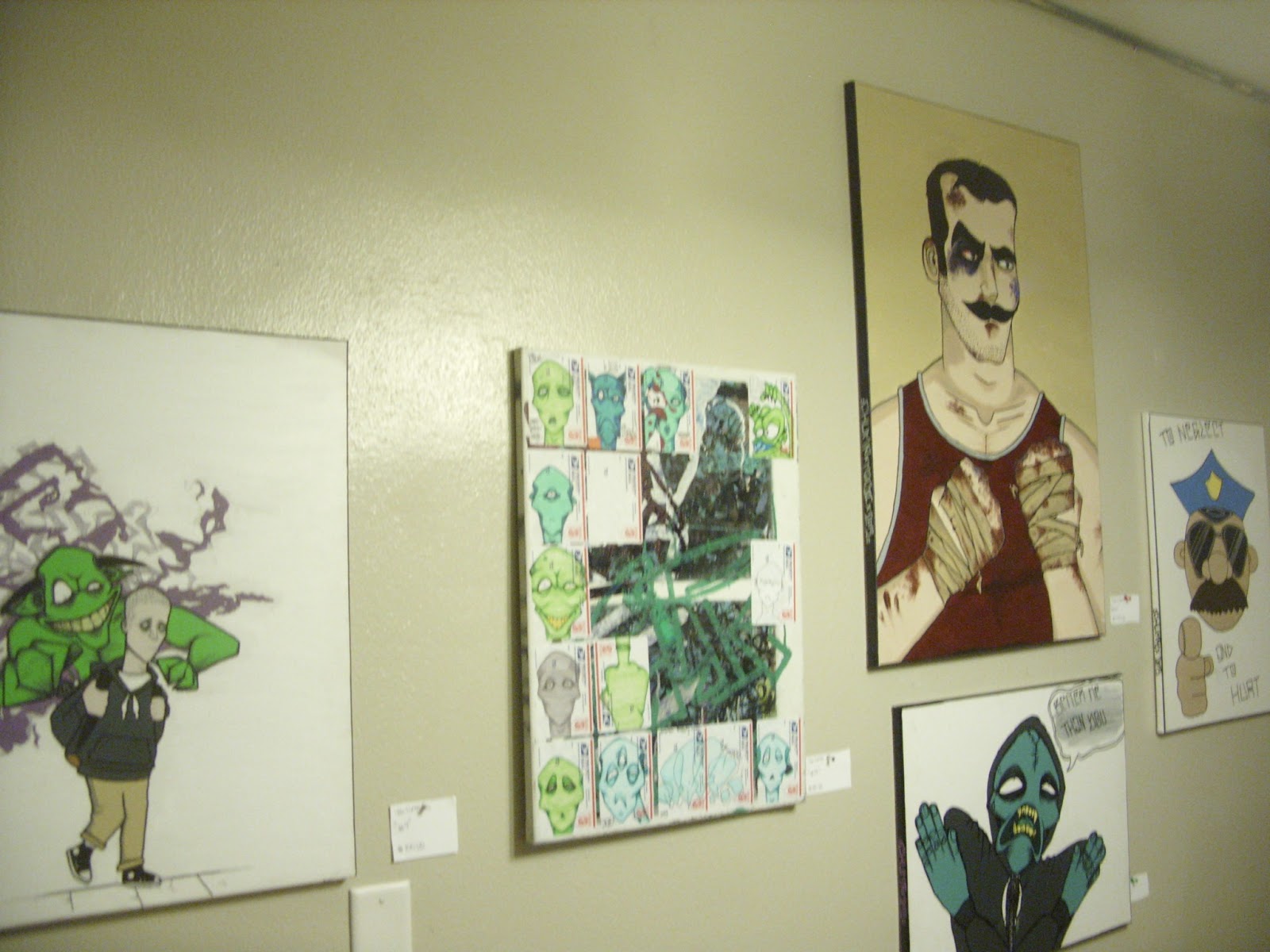
Hostel Invasion : a night of art downtown in San Diego

Hostelling International Downtown San Diego


Art is like a greater body of water in which many creatures immerse.
http://www.sandiegohostels.org/hosteltakeover

Art's journey is not complete until it goes from being envisioned to being made to being seen!


A new piece of art is made by your observations! In life, what sometimes seems indistinct grey areas, when looked at in close detail, resolves into fine lines and black and white clarity.


I feel it all working again...I had to say yes to the book I had wanted most to write with the conflict I most didn't want to exist...because now I see the end in sight...


Tuesday, September 6, 2011

Let's Draw: basic figures

Listen, since I couldn't sleep and there's this one year of Avengers written by Jim Shooter I always wanted to read, I dug in last night, and found I'd bought the first one in the series (as well as the fill-in, #169...grr) years before. The second story features Janet Van Dyne's first fashion show, and this made me want to draw a nice dress for a simple figure, and then, some nice words for my very special girl. Then I slipped it into her bag. It thanks her for all she does, basically. You get the picture.


Dawn inspired me: we want to base a comic on a model and a designer, and tonight, in the shower, some marks on her back from exercise gave me the missing piece of my Not Another Comic Book Story, then she began to fill in blanks, herself, regarding a chilling omen early in the comic. I realized, too, I could tell one key scene as dialogue after the fact without showing it, so I can stick to my strengths, which are not drawing mansions, but my downtown neighborhood, the Embarcadero and Seaport and Coronado. Now, I can return to the beach scene with Princess Sexy Jenn and company.


Another pic, from me, came while I visited her for a few minutes while she minded a front desk in another hotel, the one where we worked out and met that nice girl tonight, in fact. Oh, she had a boy who thought she was very nice, too. I sketched from my phone, for about five minutes, in an effort to convey a strong figure with simplicity.


I'll include some anatomy studies next time out; I wasn't feeling very well but with that simple sketch today, I responded to the inspiration of the many drawings Dawn Birdsong has managed in her spare time. Here, she has included Miss Bonnie Delighte with a sword, and with the wall decoration, succeeds in providing depth and dimensionality between the sword, the woman, the back wall.

All drawing is for yourself, but you will enjoy it lots more if you can think of some person who will be happy when they see what you've made. Make it from the love of the figure, and draw whatever you care about. Make it from the love of people. Make it from the love of art itself. Share THAT and your drawings will survive your long march to perfection, your Olympic training and persistence.
Drawing inspired by my recent reading and response to Englehart's Avengers run in the mid-70's.


You will find yourself drawing more! I, for one, am shifting gears---maybe as a bike shop manager?---but I do intend to draw with the same gusto with which I wrote, always writing what I wanted but savoring the doors it would open. I could not sleep tonight, already thinking of Mary Magdalene...on the moon...


Sunday, February 27, 2011

World view, artist's intentions (Neal Adams, Charlie Sheen, and more)

A Scottish professor acquaintance of mine engages in discussion with other enthusiastic creatives about world view: when we cannot separate the art from the artist, "it's Intentional Fallacy 101." I'm going to drop the literary terminology he employed for the moment; he was saying, a master artist can incorporate multiple world views, gleaned from her/his impressions. He gave Hamlet, Canterbury Tales, and Finnegan's Wake as examples, and asked: "what is the world view presented?"

I may crash and burn, but this is absolutely my standard for what I want to do in my novels, even shorter works. I'd rather crash and burn taking this chance! I even want songs that tell different biographies---but what I sing seems to require more fidelity with my world view, and generally, my feelings, as it is more of an emotional catharsis, while writing is more of an intellectual catharsis. These sorts of concerns may not play into work taken strictly for-hire, but they do play into expressive art. Hope that's clear. (And yet...not.)

This makes me curious about what a writer/ artist chooses and feels the need to draw, and if that is any different than what they need to write.

I am still getting the hang of drawing, so I'm focused on what I feel like drawing. I've already begun investing in characters not coming from the personal point of view, though they originate from my life experience.

I think even a villain should utilize some interesting part of your world view or knowledge. There's room not only for plenty of negatively-oriented characters who add to the oppression but aren't villains you can beat to enact a change---even for stories where there's no villain one can defeat, though there's much suspect behavior on display.

I imagine an artist never gets far away from drawing what they feel like drawing---and without enthusiasm, it shows!

I think the feelings invoked by the art, whichever piece we're talking about, are another matter, and create a third experience: not the art & creator, not the reader, but the overlap called interpretation, where the art mixes into your internal life, to interact with perceptions, independent of the source.

The artist cannot calculate this: in fact, that's one of the rewards, potentially, of feedback. The artist can, however, broaden the potential of her/his work to interact with a greater range of perceptions (and for that, we thank them!)

So sometimes, you may find a movie, or comic book, or song that's very well rendered in some technical aspect---let's say, a Micheal Bay film, with amazing special effects and visceral explosions and larger-than-life scale. (The example at hand was the recent work of Neal Adams.) There may be no lack of enthusiasm or attention to detail---but your emotional reaction? "Mileage may vary." (The professor in question liked it---the Professor he debated, didn't!)

Tom Cruise as a Scientologist---or perhaps, the media's coverage of his eccentricities, and over all ubiquitous presence---might influence your willingness or enjoyment of his movies. In fact, he's a great example of how a star / artist has a reputation beyond his work that becomes mixed, for the audience, with the body of work. You may find the strength of a work (and let's face it: he doesn't write or direct most of his roles) will override your outside opinions.


You might even be of a mind that an artist's world view and their work are separate. So, you might still be able to laugh at Two and a Half Men without regard for Charlie Sheen's meltdown. You might find it awfully unfunny without regard for Sheen. You may be able to listen to Chris Brown without thinking about his disastrous relationship with Rhianna; you may find it impossible to separate; and you still might identify with his struggle for redemption and change.


And just think: people without television are even further removed from the media's interpretations of artists---IF they don't look it up on the Web. Yes, there are people who read books and even live without power, too---and are they any less able to enjoy art, or a good book, without knowing much more about the artist?


You may learn about the artist's limitations in world view; you may only perceive what that artist considers and presents as a commercial approach. Your world view, of course, will play into this. What you really judge, in the end, is that other creation: the one YOU make, with your interpretation.